The Maris Review, vol 89

The theme this week is creepy old men.
What I read this week
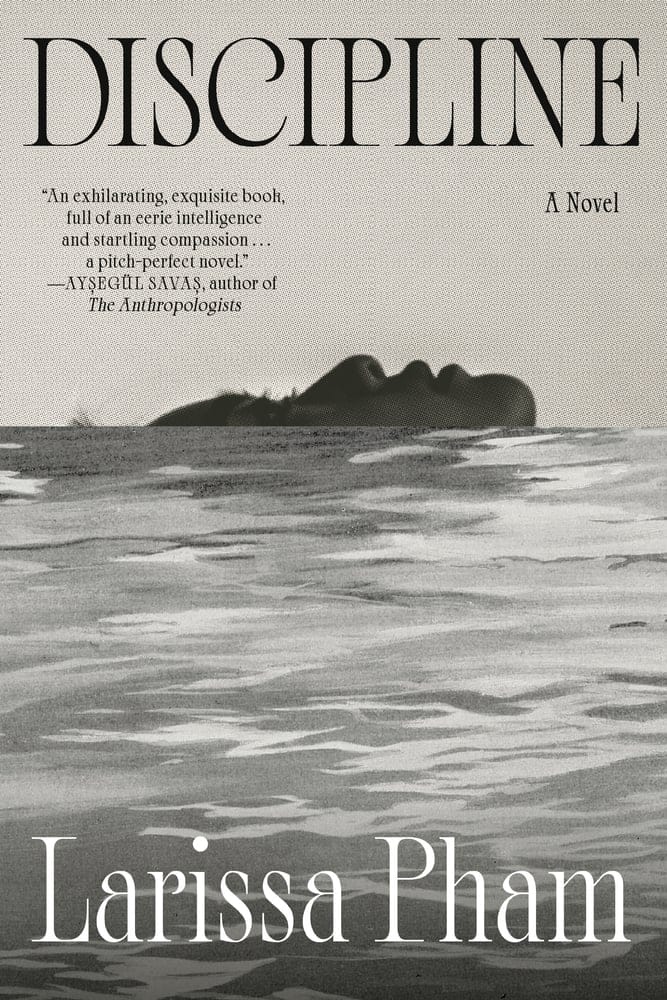
Discipline by Larissa Pham
Here's how I described this book to a friend: what if Rachel Cusk's Outline trilogy was a bit more American and contained a little bit of murder? It's not exactly the same, of course, but I think that gives you the mood of Larissa Pham's debut novel, after her excellent essay collection, Pop Song. It's got exquisitely written prose, lots of white spaces, and it allows readers to get to know the protagonist via her conversations with other people at various stops across America.
Discipline is the story of Christine, a former artist turned writer, who is promoting her debut novel on a very no frills, un-Cuskian book tour, set up and paid for by Christine herself. Christine has written a revenge fantasy novel in the hopes of getting over a painful period from her past during which her sexual relationship with a (much older) professor derailed her career as an artist. In Christine's book, the protagonist murders her former professor, exactly the kind of narrative we want from a good post-MeToo revenge fantasy. In real life, the older artist gets back in touch with Christine ("I had not prepared myself for the moment when what I thought I'd released turned, and began to chase me") and makes the entire endeavor a lot more complicated. What kind of restitution should we expect abusers to make?
The novel isn't so much invested in exploring the intricacies of Christine's relationship with the artist, although it does, beautifully. More than that it asks big questions about art and what its purpose is. Can autobiographical fiction or art of any kind can ever lead to revelation or catharsis? Is the making of art necessarily revealing of the artist, or can it help the artist hide behind artifice? Can we get so caught up in the narratives we create about ourselves and other people that we lose the plot? I love these questions, and I love this short, immaculate book that grapples with them.
Hollywood Wives by Jackie Collins
Originally published in 1983, Hollywood Wives went on to sell 15 million copies and get turned into a miniseries starring Anthony Hopkins and Candace Bergen. It came out when I was very little, and yet as I was reading it for the first time in its 40th anniversary edition, I realized how little bits of it had permeated my consciousness even then. I'd go so far to say that many of the cliches I associate with Tinsel Town and with romance novels in general in the 1980s come from this ridiculous, trashy, entirely fun novel: facelifts and water beds and "hookers" and "heaving bosoms" and "bored Beverly Hills housewives who elevated cocksucking to an art." There is one thing that happens in this book that I thought for sure was just a sexual urban legend, but maybe this is where the urban legend originated? You will know it when you see it, I promise.
Anyhow, it was a wonderful escape to visit the land of users and abusers and manipulators, becoming intimate with a huge cast of characters including a reformed hustler who strives to become legit for his prim but exceptionally hot wife, a nepo baby with enormous nipples (???) who's fucking her best friend's husband, an A-list actress who seemingly got everywhere in life because of her big naturals, and a serial killer. It's all absurd, but the construction of the plot is seamless. All of the action in the novel leads up to a big party that takes place about three quarters of the way through, and I'd rank it up there with some of the greatest party scenes in literary history. I'll leave you with some of the snippets of conversation from the party, which Jackie Collins peppers throughout.
"I should never have turned down Raging Bull," said the actor in the lizard skin boots. "That was a key career mistake."
"He pays me. I think it turns him on," said the redhead in the mink-trimmed cape.
"I buy them dresses, take them to Acapulco, I've gotta give them head too?" asked an outraged stud.
A word on the Black Dahlia
There's a new true crime book out today that ordinarily I would be so excited about: Black Dahlia: Murder, Monsters, and Madness in Midcentury Hollywood by William J. Mann. Actually, I'm still excited about it, but I'm going to read it with a big fat caveat. Two of the authors/journalists/crime writing experts I trust the most, Sarah Weinman (here she is in The Atlantic) and Elon Green (here he is at Defector), are skeptical that the person Mann pins the crime on in the new book is the actual killer. Elon's piece contends that Michael Connelly's podcast about the Zodiac Killer, which also names the man who was identified in Mann's book as the serial killer of the later 1970s, is egregiously wrong.
So I might skip the whole thing entirely. But still, allow me to point you towards Sarah and Elon's most recent books if you want true crime that consistently centers the victim and doesn't look for easy answers:
Without Consent: A Landmark Trial and the Decades-Long Struggle to Make Spousal Rape a Crime by Sarah Weinman
The Man Nobody Killed: Life, Death, and Art in Michael Stewart's New York by Elon Green
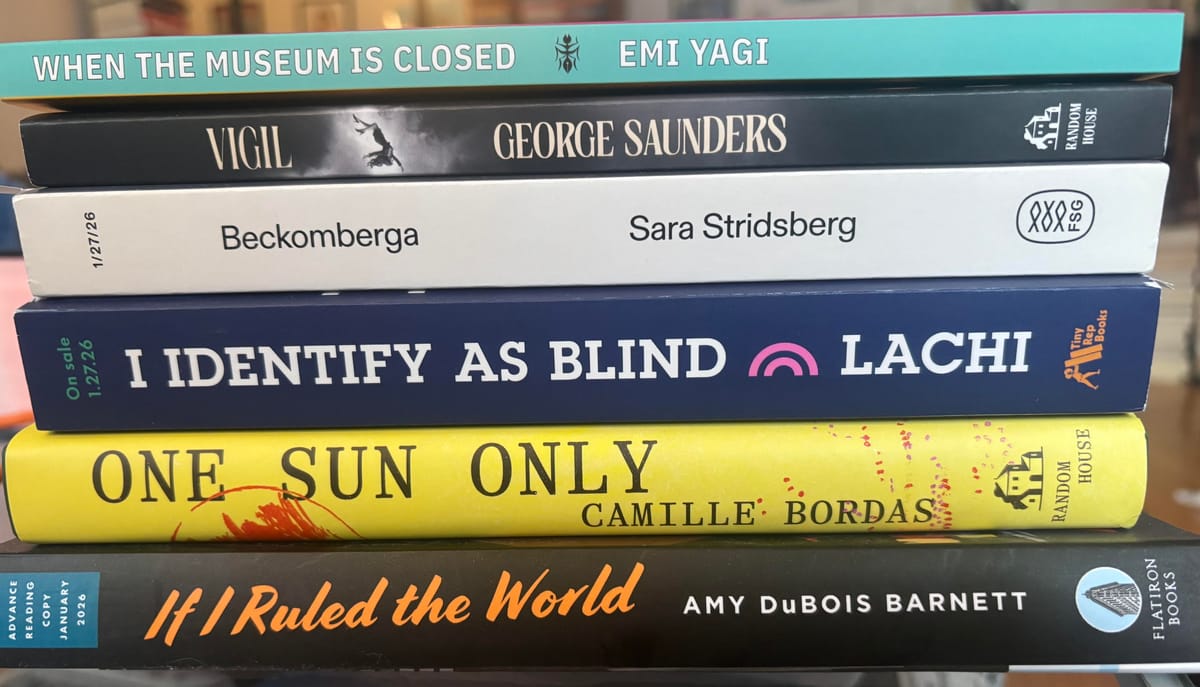
New releases, 1/27
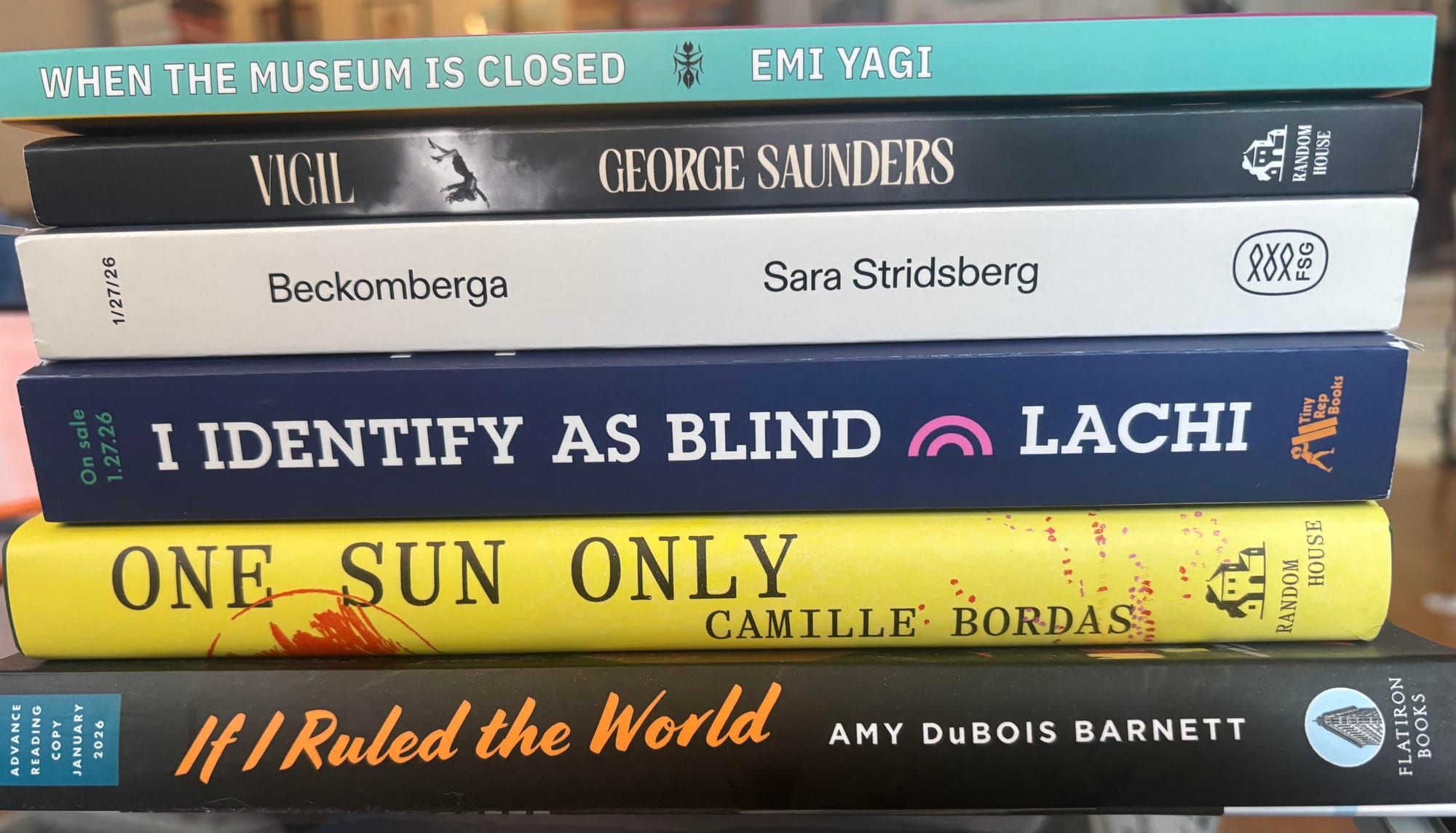
When the Museum Is Closed by Emi Yagi
Vigil by George Saunders
Beckomberga by Sara Stridsberg, translated by Deborah Bragan-Turner
I Identify As Blind: A Brazen Celebration of Disability Culture, Identity, and Power by Lachi with Tim Vandehey
One Sun Only: Stories by Camille Bordas
If I Ruled the World by Amy DuBois Barnett
TS Eliot: An Imperfect Life by Lyndall Gordon
Escape from Capitalism: An Intervention by Clara E. Mattei
Everyone Hot Pot: Creating the Ultimate Meal for Gathering and Feasting by Natasha Pickowicz