The Maris Review, vol 94

The theme of the week is poetry in unexpected places.
What I read this week
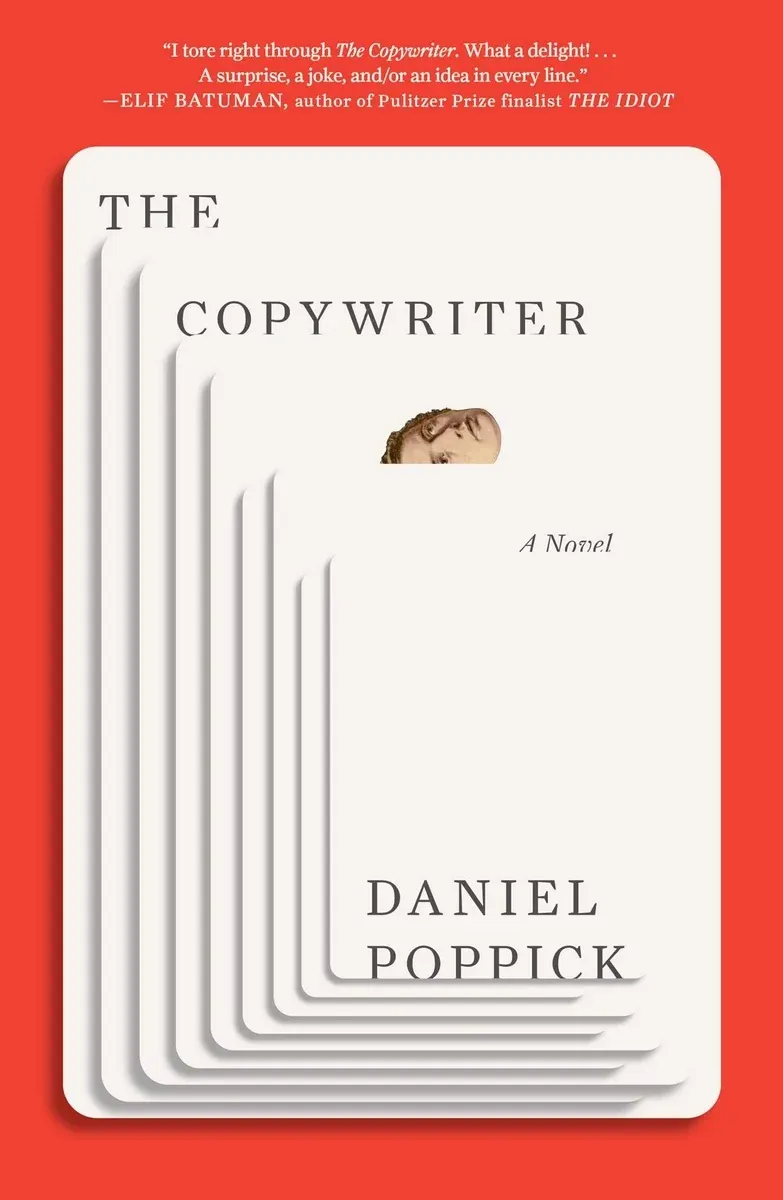
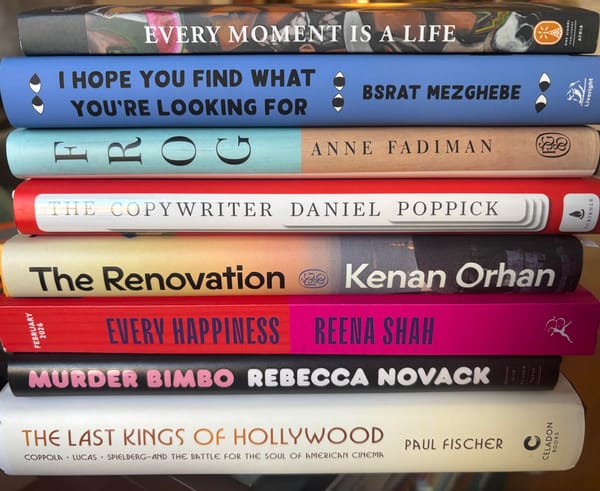
The Copywriter by Daniel Poppick
Not since Hannah Horvath worked in advertorial at GQ has a true artiste's creative energy been so stifled by a day job. Daniel Poppick's debut novel is the story of D__ , primarily a poet but a copywriter by day, burdened by the absurdity of trying to make soulful product descriptions for useless junk. Yet still, there is poetry to be found, D__ tells us, even in the most depressing/capitalist/soul-crushing of places. It's that openness to finding poetry in anything, anywhere, that elevates the novel, although all of the office life satire is spot on.
The Copywriter consists of D__'s notebooks from 2017 to 2019, during which he experienced a breakup, a layoff, a failed cross country road trip, and the reading of the entirety of In Search of Lost Time. Mixed in to more diary-like entries are poems and parables and dream descriptions and mundane observations and random thoughts about the fascist president (he is never named; add this to the list of novels from the past decade in which he is described but never named). At their best moments all of these snippets, expertly juxtaposed, can build to more profound ideas.
The book is at its most compelling when its concerns are more philosophical than poetic, such as when D__ contemplates the moral tradeoffs of working, and receiving health insurance, under capitalism. D__ reaches a breaking point when he's asked to write snappy descriptive copy for a Jewish arts and recreation center (also unnamed but very, very easy to deduce) for a coming speech by a Jewish American refugee turned politician turned war criminal (also not named in The Copywriter, unlike in Tina Brown's memoir where his name is mentioned on seemingly every other page!).
Does every sentence sing? Not entirely. But the concept of the novel as unfiltered writer's notebook is a lovely way to interact with the messy delights of newly-forming ideas and unrefined first impressions.
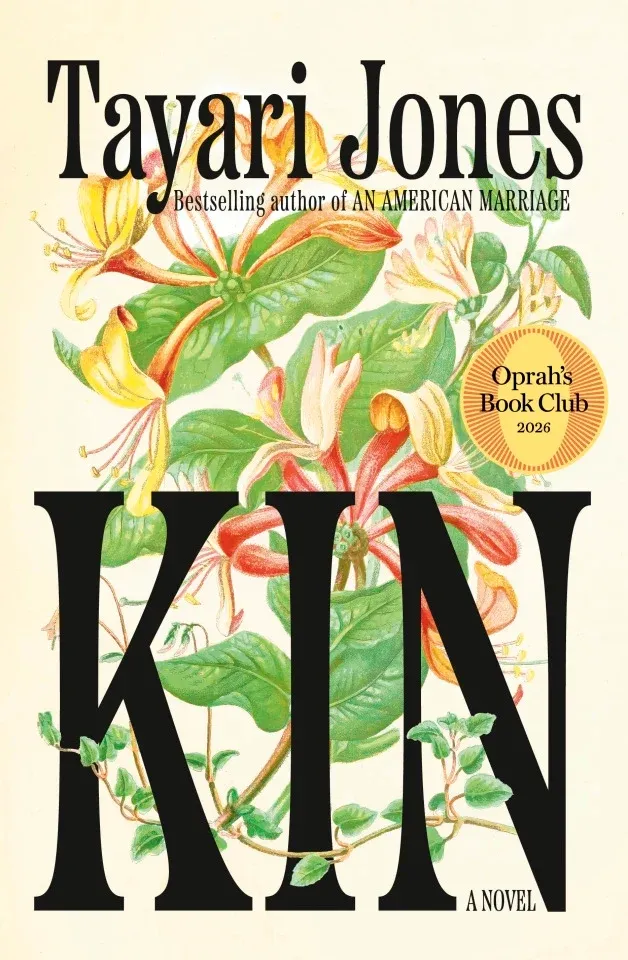
Kin by Tayari Jones
Am exquisitely detailed novel about a friendship between two women that begins almost at birth, Kin is the story of "cradle-friends" Vernice "Niecy" and Annie. Born in the 1940s in the town of Honeysuckle, Louisiana, both girls are parentless – Niecy's father murdered her mother and then killed himself right after she was born, Annie's "trifling" mother abandoned her when she was very tiny. That missing piece of themselves is what first bonds the two girls. As is often the case in stories about mother-loss, Kin becomes a poignant as hell reflection on the pleasures and deficiencies of found family.
The two friends narrate alternating chapters of the novel as they come of age in the Jim Crow South and take two entirely different paths after high school. Niecy becomes "Mouse," as in "country mouse," when she moves to Atlanta to attend Spelman College and enter an entirely new strata of society. Her learning takes place almost entirely outside of the classroom, as her ambitions are more social than academic. She longs to be accepted into a well-to-do family, and to one day become a mother herself.
Meanwhile, moves to Memphis with her boyfriend and his cousin (and, spoiler alert: her boyfriend's actual girlfriend), living a humble yet mostly happy working class life with her three companions and working as a bartender at a hole-in-the-wall called the Elektra. However, Annie's obsession with tracking down her wayward mother, who may also live in Memphis, threatens to upend her mental health, if not her life.
Through it all the friends write to each other, revealing some of their secrets while hiding others, until eventually they end up together again. It's impossible not to fall in love with both of them. It's also difficult not to feel a vast sense of regret for the many gains of the 1960s civil rights movement that are unraveling or have been undone in our current moment.
My only trifling complaint about Kin is that it's book clubby as hell. Not that this is the author's fault in any way. But I can imagine how good it will feel for a certain set of middle aged ladies (I am one) to learn a lesson or two about racism and empathy before going back to drinking their wine.
My 50th Lit Hub column
Yesterday morning I submitted an invoice for the 50th column I've written for Lit Hub. That's enough for a whole short book! It would be called The Books Are Still Good But the Industry Is Bonkers. Take a look. I hope it's been clear that I critique the publishing industry so hard because I still believe in it. Regular readers of the newsletter will know that every single week (maybe except for the last two weeks of the year) new books get published that I very much want to read. If only I could convince enough other people that they would very much want to read those books, too. Anyhow, glad you're here.
New releases, 3/3
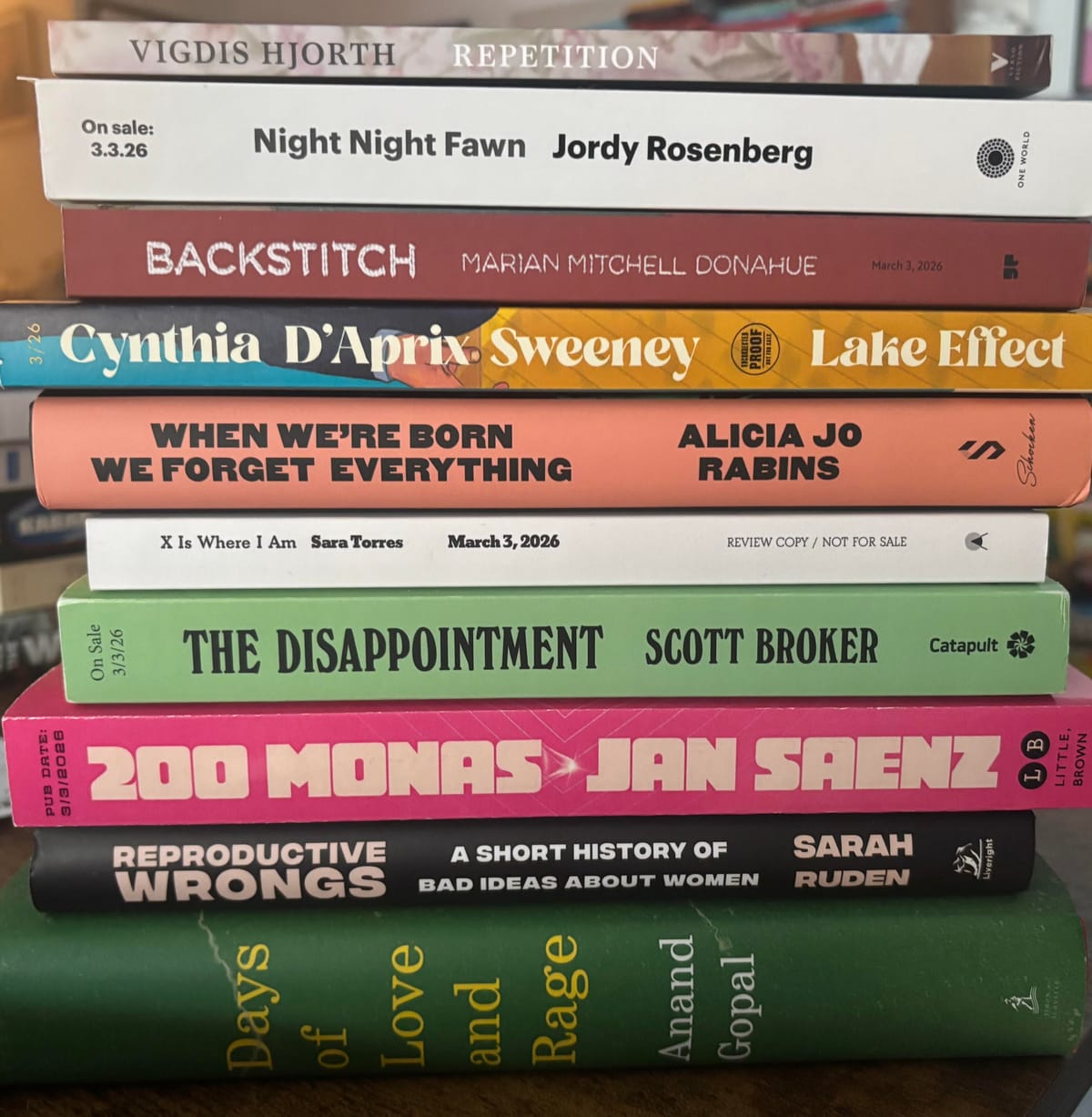
Ever since I realized in 2024 that March has become THE big release month, it's made me feel less frantic about trying to keep up with every new book. It's exciting that so many books are being published today, but as always, I'm afraid many will get lost in the shuffle. Look around down below. There really is something for everyone.
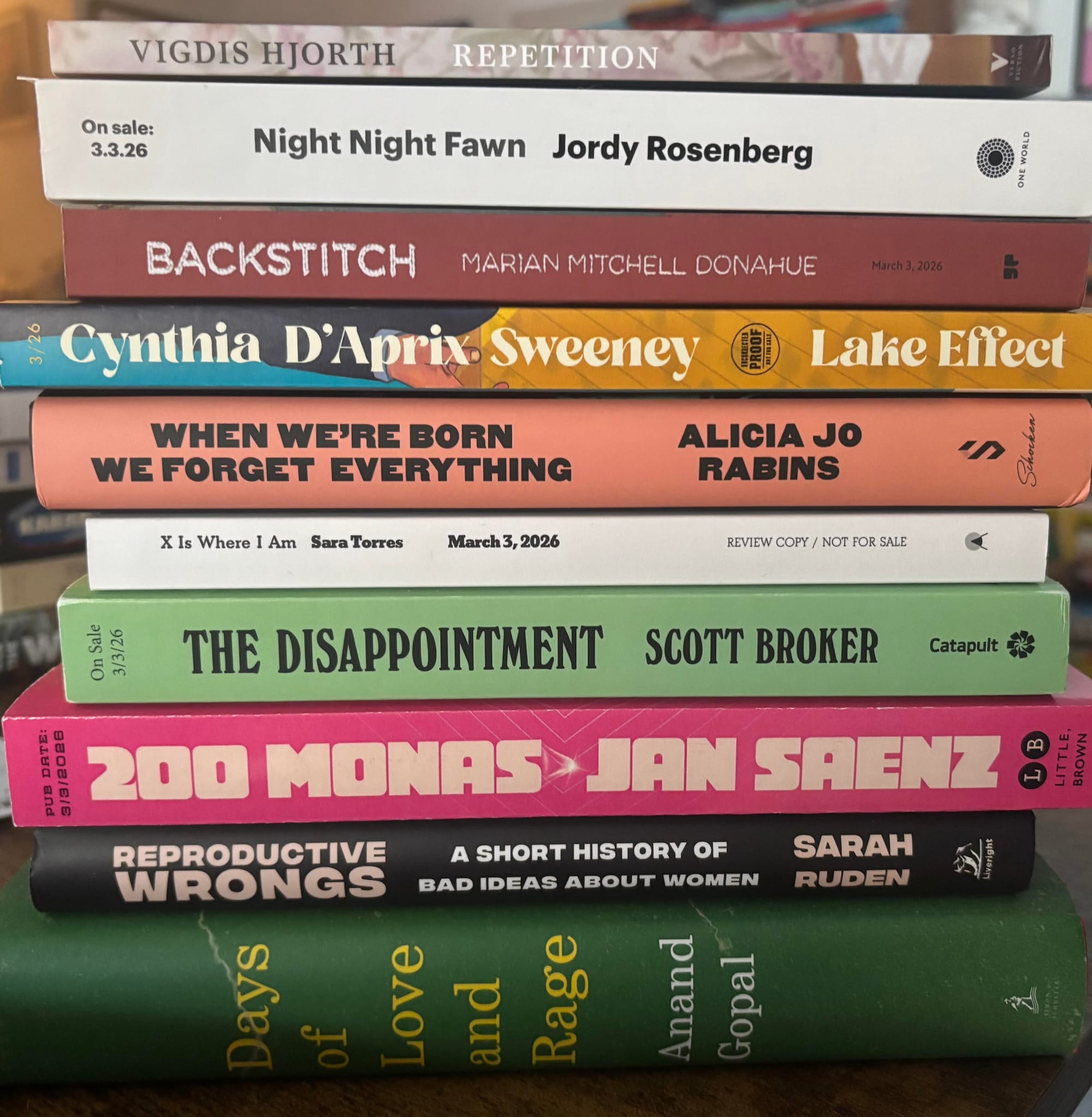
Repetition by Vigdis Hjorth
Night Night Fawn by Jordy Rosenberg
Backstitch by Marian Mitchell Donahue
Lake Effect by Cynthia D'Aprix Sweeney
When We're Born We Forget Everything by Alicia Jo Rabins
X Is Where I Am by Sara Torres
The Disappointment by Scott Broker
200 Monas by Jan Saenz
Reproductive Wrongs: A Short History of Bad Ideas About Women by Sarah Ruden
Days of Love and Rage: A Story of Ordinary People Forging a Revolution by Anand Gopal
Will This Make You Happy: Stories & Recipes from a Year of Baking by Tanya Bush
The Beginning Comes After the End: Notes on a World of Change by Rebecca Solnit
Wait for Me by Amy Jo Burns
Let the Poets Govern: A Declaration of Freedom by Camonghne Felix
The Valley of Vengeful Ghosts by Kim Fu
Now I Surrender by Álvaro Enrigue, translated by Natasha Wimmer
El Paso: Five Families and One Hundred Years of Blood, Migration, Race, and Memory by Jazmine Ulloa
Suspicion by Seichō Matsumoto, translated by Jesse Kirkwood
Diorama by Carol Bensimon, translated by Zoë Perry and Julia Sanches
Where the Girls Were by Kate Schatz
Gunk by Saba Sams