The Maris Review, vol 98

The theme of this week is primogeniture.
What I read this week

The Keeper by Tana French
Tana French is a stop-everything-and-read author for me, and so I was lucky when the audiobook version of The Keeper was uploaded to the PRH audio app last week just when I was feeling lonely. Josh is away on business for a while, and a 19-hour audiobook featuring a variety of Irish brogues was exactly what I needed. I finished much too quickly.
The final book in a trilogy, The Keeper concludes the story of Cal Hooper, a retired Chicago cop who moves to the village of Ardnakelty in Western Ireland in Book One. Cal is disillusioned with the word of policing, just as Tana French has become disillusioned with copaganda, and I so appreciate that. Still, I miss French's Dublin Murder Squad fiercely. I miss its fast pace, I miss those damn lovable cops (and some of the assholes). I know, I'm a mass of contradictions! But if you want to know where to begin with French's other work, start with the first book, In the Woods, and plough straight through.
In The Keeper Cal is really starting to fit in. He's got a fiancee, Lena, and his former adversary, Trey, has become his mentee and a daughter-figure. They've got a bunch of dogs. Cal's neighbor, Mart, has become something like a friend. The village of Ardnakelty, always a major character in the series, gets an even bigger presence this time around: its alliances and grievances, its gossip and secret codes. Cal is still a relative newcomer to Ardnakelty, where most of the people in the village have been in each others' lives for generations, so if he wants to put roots down he has to learn all of the town's unwritten rules. And if Trey, who finally has a group of friends of her own, wants to stay in town after high school, she will have to do the same.
The action of The Keeper begins when a 20-ish young woman named Rachel comes to see Lena one evening, seemingly looking for advice. Hours later Rachel's body is discovered in the river. She has drunk Antifreeze.
Rachel was nearly engaged to Eugene, the weasel-y son of Mart's nemesis Tommy Moynihan, who runs the meat processing plant over towards Kilhone and is therefore "Mr. Big-Balls in this townland." According to Cal, Tommy has "a farmer's solid bulk, a politician's frozen silver hair, a C-list cattle baron's ranch house, a Range Rover the size of a buffalo, and an annual family holiday to Mexico." When Tommy asks Cal to investigate Rachel's death on his behalf Cal turns him down, but that doesn't stop Cal from investigating on his own. Ostensibly Cal is investigating a death, but more so he must figure out the power dynamics in Ardnakelty to understand what happened to Rachel and why.
The dialog in The Keeper is as sharp as ever. We spend a lot of time with Cal and his buddies in the pub talking over Guinness and toasties (I liked their conversation about rizz) , and we even get Lena and some of the women of the town gossiping over vodka and Cokes. There is so much darkness in Ardnakelty, but in this novel there are more moments of levity than ever. It's lovely to hang out with the people of the town, to see how they think and how they speak and what makes them laugh. It's the ability to enjoy the craic that signifies that Cal is really home.

The Complex by Karan Mahajan
"How had the worst person in the family become its doyen? Or was this the fate of all groups? That power accrued to the person with the most energy, regardless of whether that energy was good or evil?" These are the questions that Gita Chopra asks about her husband's not-much-older uncle, Laxman, towards the end of Karan Mahajan's third novel, The Complex. In the opening pages Gita, on a solo trip back to Delhi after a move with her husband to America, is assaulted by Laxman at a Chopra family party in 1980. We follow Gita and her loneliness in America and her trouble conceiving and her husband's critical work in designing a plastic squeezable ketchup bottle in their small Michigan town, but ultimately The Complex becomes more Laxman's story than Gita's. Remember how I was just talking about Tommy Moynihan and what a big fish in a very small pond he is? Laxman is the Tommy Moynihan of Delhi.
Laxman is one of nine children of the once great political leader SP Chopra, whose legend looms largely over the rest of the family. Many of Chopra's descendants and their families live together at A-19 Modern Colony, an overcrowded compound in Delhi that SP had built right after partition but that has now seen better days. I know I have the tendency to romanticize the way that extended families of the East stick together, but The Complex portrays such relationships as multigenerational hell. We see how oppressive it is to be devoid of privacy, to be surrounded by bickering family members constantly.
The cast of characters isn't quite as big as you might imagine, however. We don't get to see many rooms in the complex. The narrative is mostly concerned with one space: the one Laxman and his wife share with his nephew Brij and Brij's wife, Karishma. There they love and fight and start a couple of businesses together and ultimately allow Laxman to get away with a ton of shit, rape-y and otherwise (Laxman's level of self-awareness reminds me of the narrator in Teju Cole's Open City, the villain who can be nothing else but the hero of his own story).
It's only fitting that this incredibly flawed but charming man, after being an entrepreneur and a shady businessman, becomes a politician. We watch in horror as Laxman's own character development coincides with a new strain of Hindu nationalism that oppresses India even now.
Do me a favor and call your rep

Two weeks ago I wrote about a disastrous bill, the first national attempt to ban books. HR 7661 seeks to remove any book that “involves gender dysphoria or transgenderism” from all public schools in the entire US under the guise of it being "sexually oriented.” The bill has somehow moved out of the House Education Committee and is awaiting a potential floor vote. It's time to act. Please call your reps and let them know you oppose HR 7661. Here is a handy link to help.
Stay tuned for next week

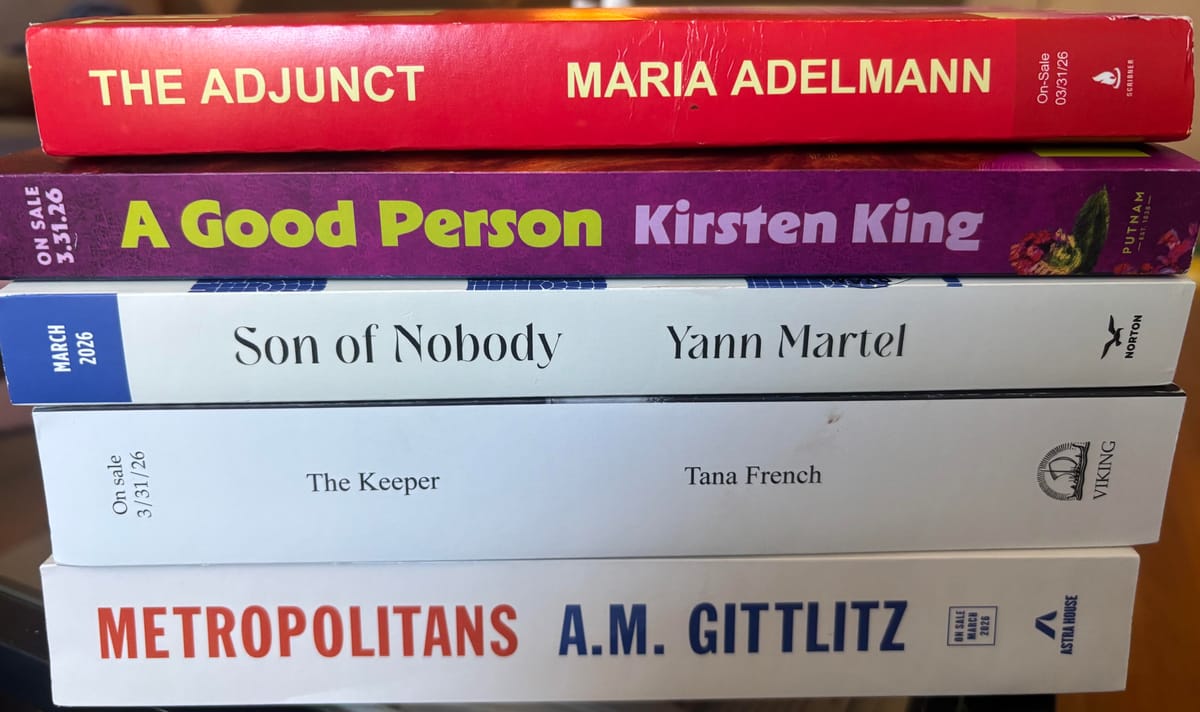
New releases, 3/31
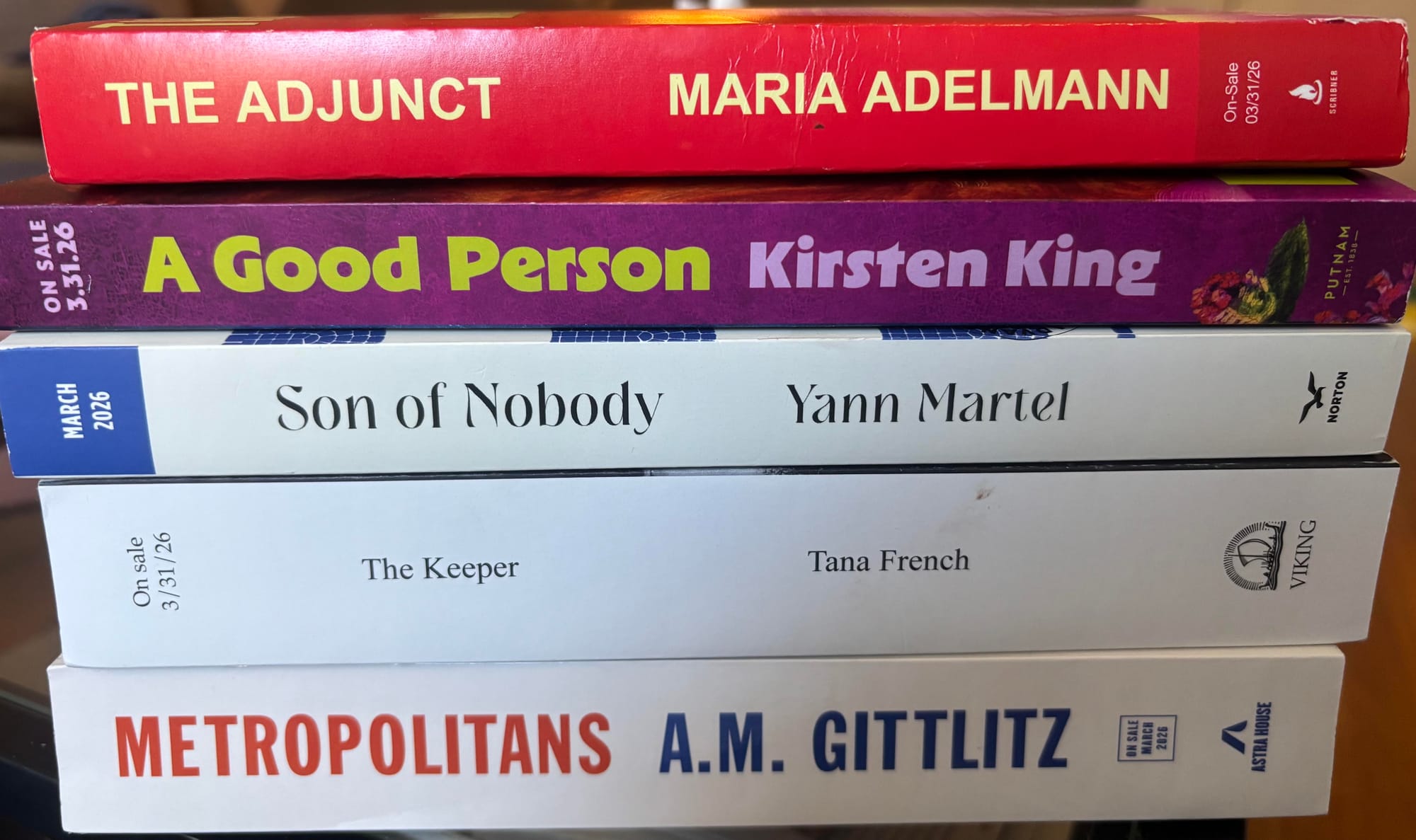
The Adjunct by Maria Adelman
A Good Person by Kirsten King
Son of Nobody by Yann Martel
The Keeper by Tana French (see above)
Metropolitans: New York Baseball, Class Struggle, and the People's Team by A.M. Gittlitz
Upward Bound by Woody Brown
Ruins by Lily Brooks-Dalton
American Han by Lisa Lee
True Color: The Strange and Spectacular Quest to Define Color--from Azure to Zinc Pink by Kory Stamper