The Maris Review, vol 115

This week's theme is what happens (nothing good!) when you mine your life for material for your fiction
What I read this week
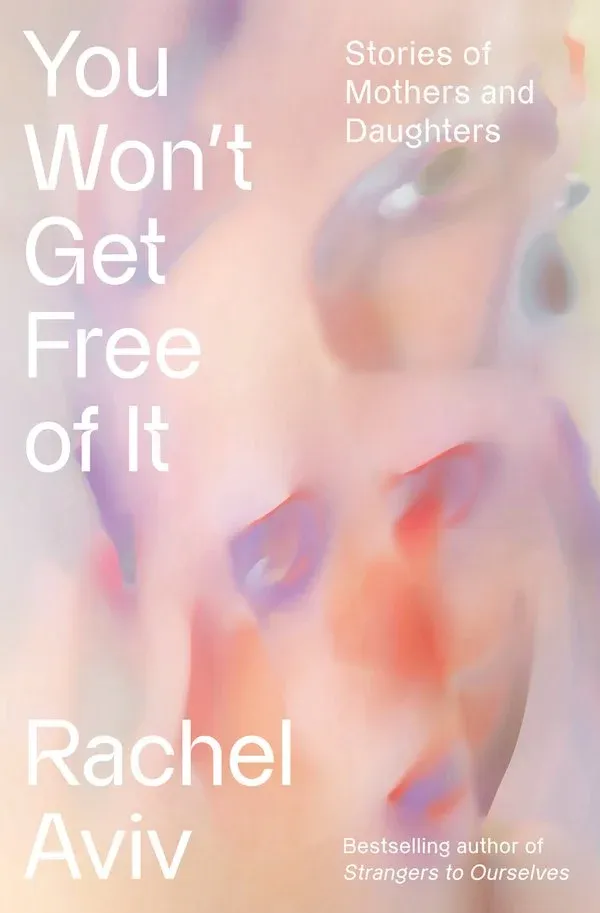
You Won't Get Free of It: Stories of Mothers and Daughters by Rachel Aviv
Rachel Aviv has one of my favorite journalistic beats. She writes a lot about memory and perception and how imperfectly we tell ourselves and others the stories of our lives. I talked to her about her previous essay collection, Strangers to Ourselves, and had a great discussion about how people with severe mental illness often can't trust their own experiences, how mental illness turns its sufferers into unreliable narrators.
This new book consists of six essays originally published in the New Yorker that Aviv revisited and refined and added reporting to. The relationship between mothers and daughters is the theme of the collection, but it doesn't have to be. Maybe my hackles rise when I think someone's saying that I won't understand something or "get it" because I'm not a mother, and this was not the case here. You only have to be a person in the world to be fascinated by the blind spots and misperceptions that impede our personal relationships, often making our loved ones unknowable in many ways. As with the previous collection, do not expect to find any easy answers here – Aviv would never tie any story up with a little bow. The human brain is much too unwieldy to fit into a neat narrative structure.
The title of the collection takes it's name from a quote in an Alice Munro story about a woman leaving her children for a man. I still remember where I was when I read Aviv's New Yorker piece about the Munro family originally, how disturbing and disappointing and profoundly sad I found it. I knew that Munro had always mined her life for material, but I didn't realize she did so in this very particular, thorough way – that Munro was aware that her youngest daughter had been sexually abused by her current husband, with whom she stayed, and that Munro explicitly wrote stories about them. I got rid of the majority of my Munro collection right afterward. I would never be able to separate the art from the artist when the art came directly from the artist's willful compartmentalization of her daughter's suffering. Aviv's new additions to the piece make the story stranger and more tragic, but there is also hope to be found in the last pages.
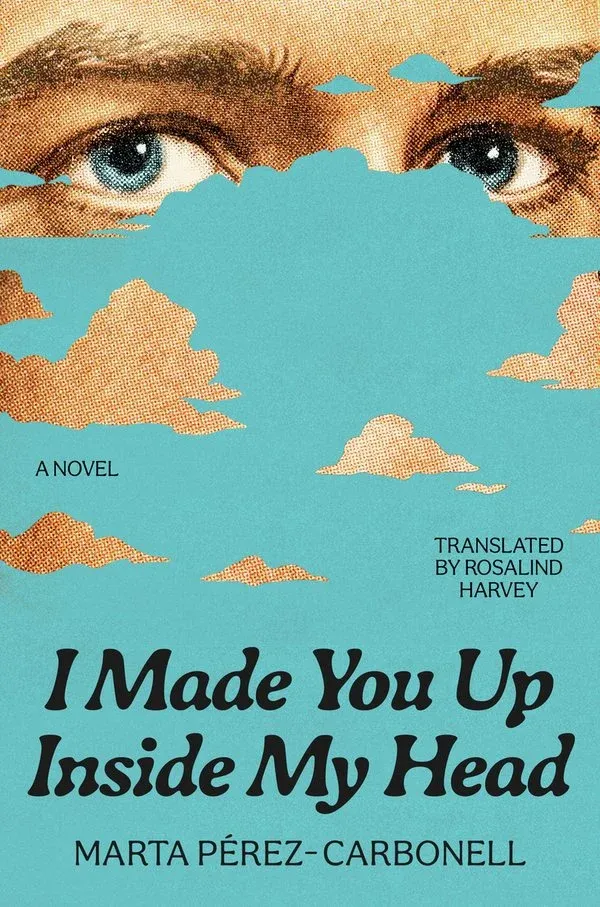
I Made You Up Inside My Head by Marta Pérez-Carbonell, translated by Rosalind Harvey
We are very much on theme this week. If Rachel Aviv uses reporting to illuminate the instability of perspective, then this excellent debut novel explores the same through fiction: "Every story hides more information than it reveals." I Made You Up Inside My Head is very much about the troubles with mining one's own life and the lives of others for material to use in art. It's also about how, when disparate stories come together even if for a short time and by coincidence, we tend to group them in our heads and draw parallels. That's basically what I do in this newsletter every week.
Marta Pérez-Carbonell's heroine is Alicia, a translator from Madrid who takes an overnight train from Edinburgh to London where she encounters Terence and Bo, an older American writer and his younger mentee, and their lives briefly intersect. What a wonderful cliche "strangers on a train" is! In talking to them Alicia learns that Terence has recently published a novel that may or may not have ruined a real man's life. Terence loosely (or not so loosely?) based a character on a man he'd known and been intrigued by, but who is now missing. Did Terence give too much away? Along with Alicia we get to hear Terence's version of events, as well as to read some of the text from his novel. And, of course, our brains and Alicia's begin to fill in the details about characters when the author leaves a description vague enough. We're left with provocative but incomplete story that speaks to the unknowability of the people who populate a writer's imagination and the pages of their books.
Welcome to book influencing, Katie Porter
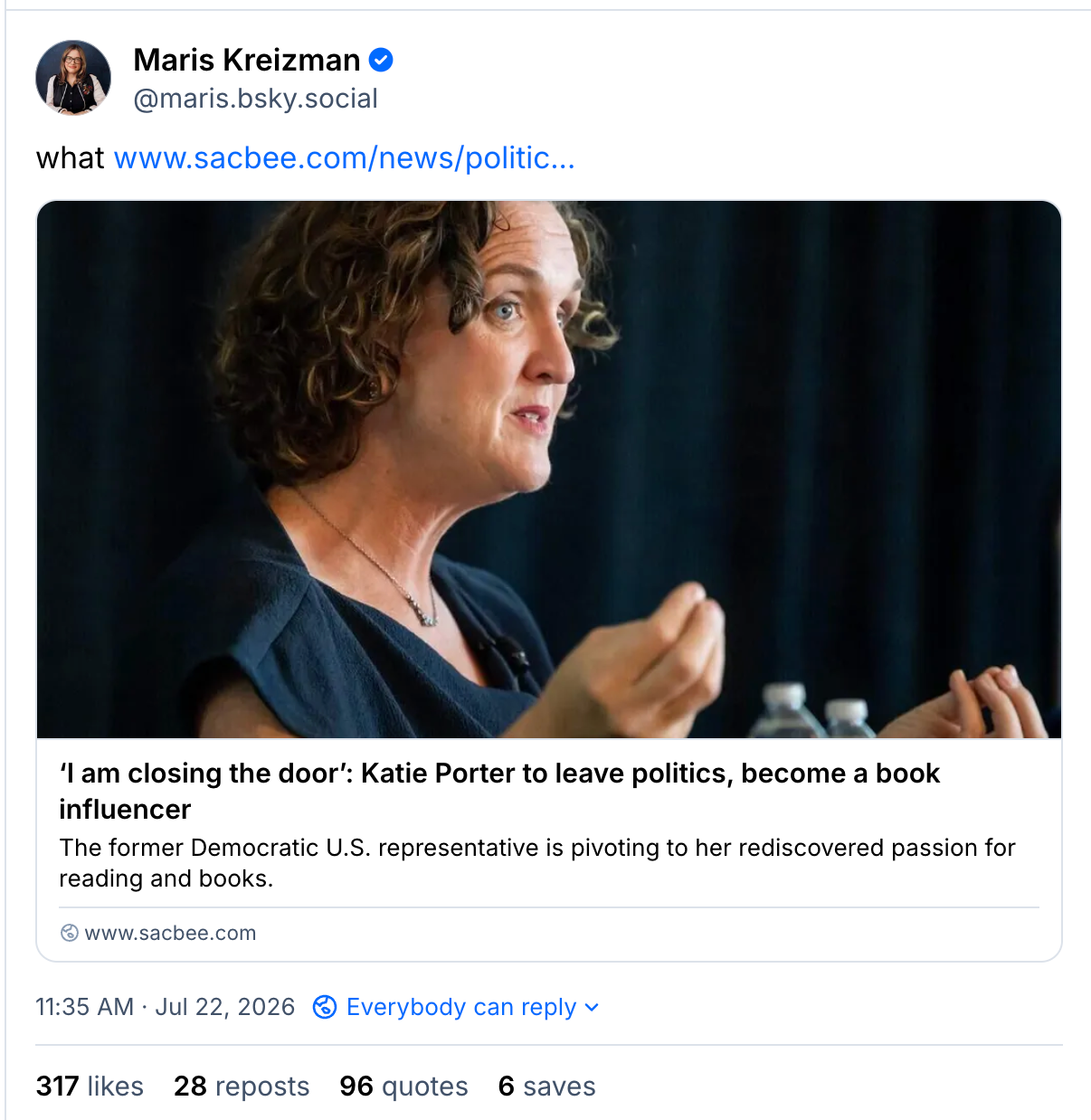
We got to have a little fun last week at Katie Porter's expense, due to this absolutely bonkers headline.
Why would a (somewhat disgraced) politician say goodbye to all that in order to talk about books instead? Because that's where the power and money is, obviously! (But seriously if you can afford to become a paid subscriber to my newsletter I would really, really appreciate it.)
Here's an easy link.
But anyway, here are a list of topics that I feel Katie Porter should be ready to discuss if she's serious about this whole thing:
--predictions for Booker shortlist
--favorite/most overrated weird girl lit
--does listening to audiobooks count as reading?
--Goodreads, Storygraph, or other?
There's only one entity that shouldn't be narrating audiobooks
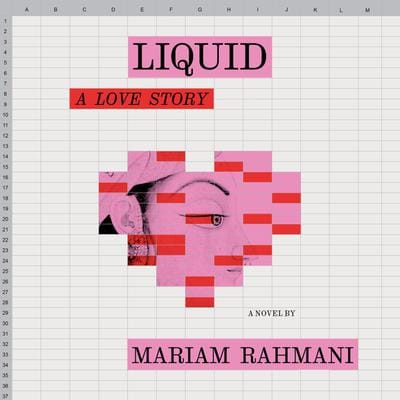
For last week's Lit Hub column I wrote about whether the author or a professional voice actor was a better candidate to narrate a particular audiobook, and of course the answer was both are great! As long as it's a human reading and interpreting the book and not AI, which seems to really be coming for audiobook narrators. Lots of good suggestions inside.
New releases, 7/28
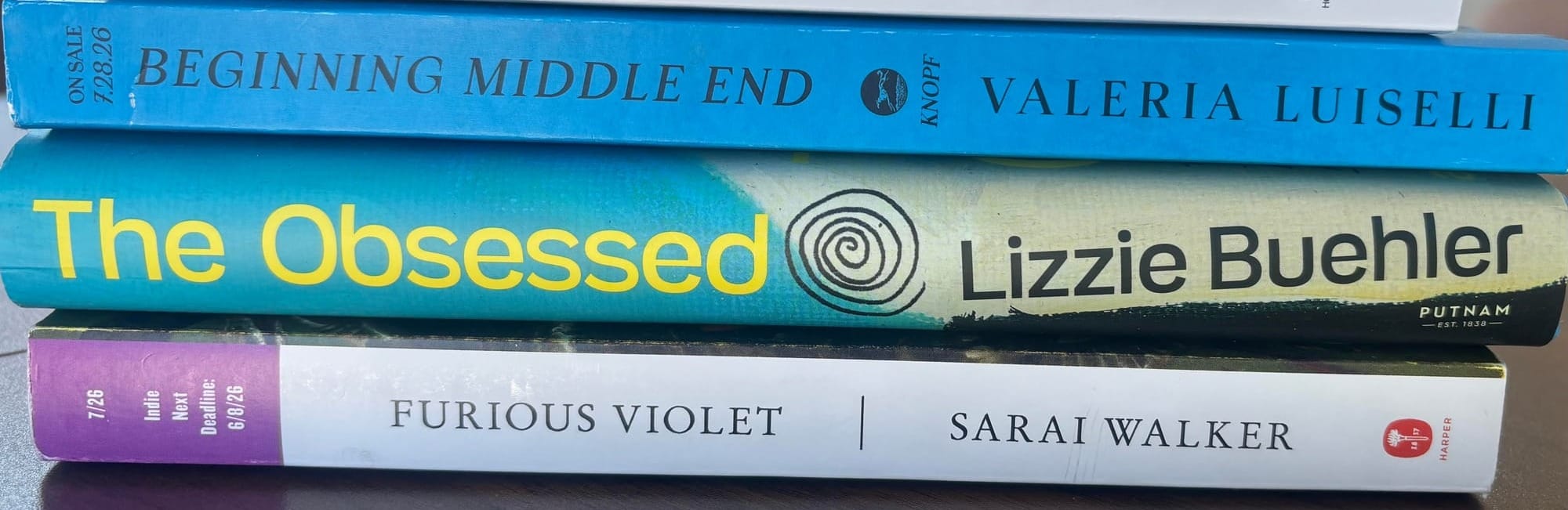
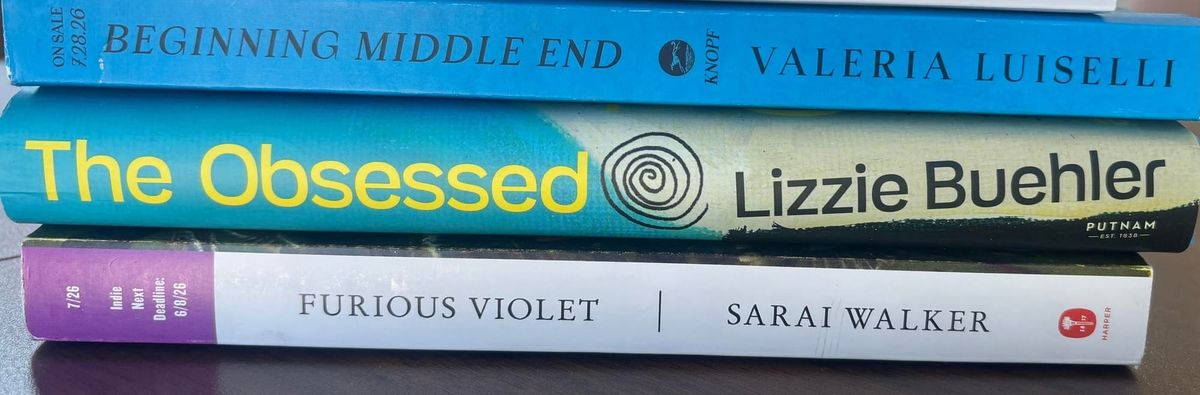
Beginning Middle End by Valeria Luiselli
The Obsessed by Lizzie Buehler
Furious Violet by Sarai Walker
I Made You Up Inside My Head by Marta Pérez-Carbonell, translated by Rosalind Harvey
(see above)
Biological War: A Scenario by Annie Jacobsen
All My Dead Cats and Other Losses: Practicing Good Grief in a Culture That Fears Mourning by s.e. smith
All That's Unseen: An Appalachian Memoir by Emilee Hackney
Liberation Summer: The Moment That Changed the Women's Movement and the Future of American Politics by Micki McElya
The Winds of Maracaibo by María Elena Morán, translated by Madeline Jones
Few and Far Between by Jan Carson