The Maris Review, vol 128

The theme of the week is what we owe our (or other people's) mothers
What I read this week
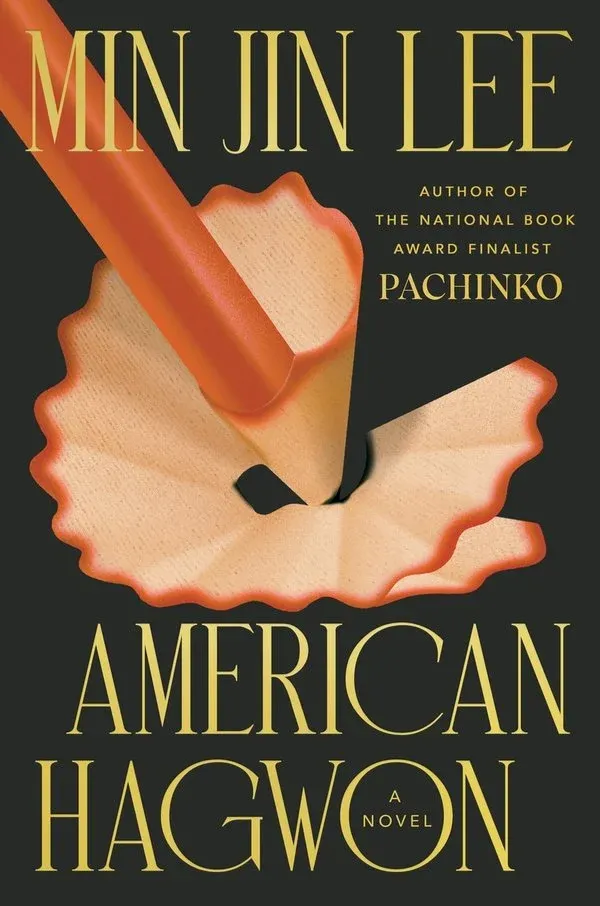
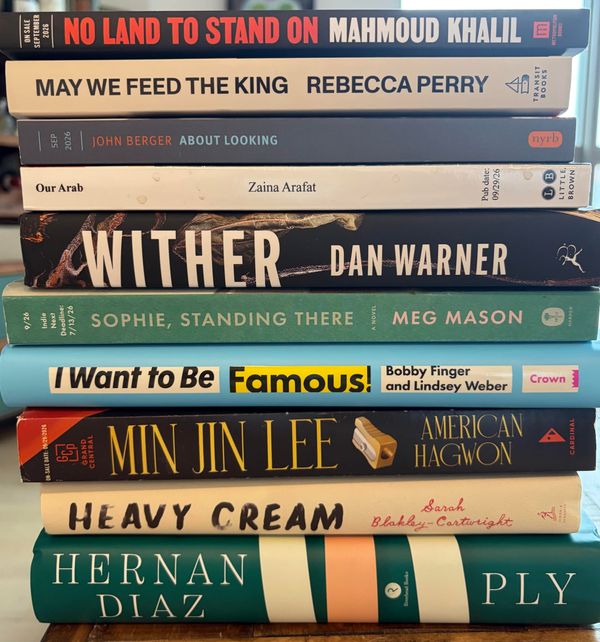
American Hagwon by Min Jin Lee
I've never read an epic that was primarily about education – both practically and philosophically – but Min Jin Lee's new one is primarily concerned with what it means to learn. Instead of a novel with a traditional marriage plot, you could say American Hagwon has more of a diploma plot where the goal is an education rather than a wedding ring.
Exemplified by the three Koh siblings who grow up in America and Korea and Australia in the 1990s and early aughts, Lee's latest novel is concerned with different paths to enlightenment. The idea that there's more than one way to learn is subversive when ultra-competitive Korean and Korean American culture dictates that the only path to success is to attend a Korean "SKY" university or one of the American Ivies. This leaves Korean children under terrible pressure to achieve this one goal, buoyed by after school tutoring centers called hagwons that are meant to prepare them for their higher educations. But what if there are other ways of being successful. And even... happy?
The parents of the Koh siblings are John and Helen, who happen to be perhaps the most noble couple in recent American fiction. They are fundamentally good and they are hard-working and ambitious and they do not complain even as their fortunes change with the times. Their children inherit this goodness in a way that makes them utterly dutiful but with almost no sibling conflict at all. The novel often feels more like a wish than a deeply realistic portrait. And that's okay. We need our fantasies.
In fact, American Hagwon spans continents and decades and feels epic in scope but amongst the huge cast of characters we get to spend time with, very few have any major moral flaws (aside from one villainess who has her reasons, and one weak-minded man who succumbs to her charms). Think of it more like a parable in which goodness prevails and family duty trumps all, but one that leaves plenty of space for character development in other areas like how to depend on other people and how to trust yourself with your most important life decisions.
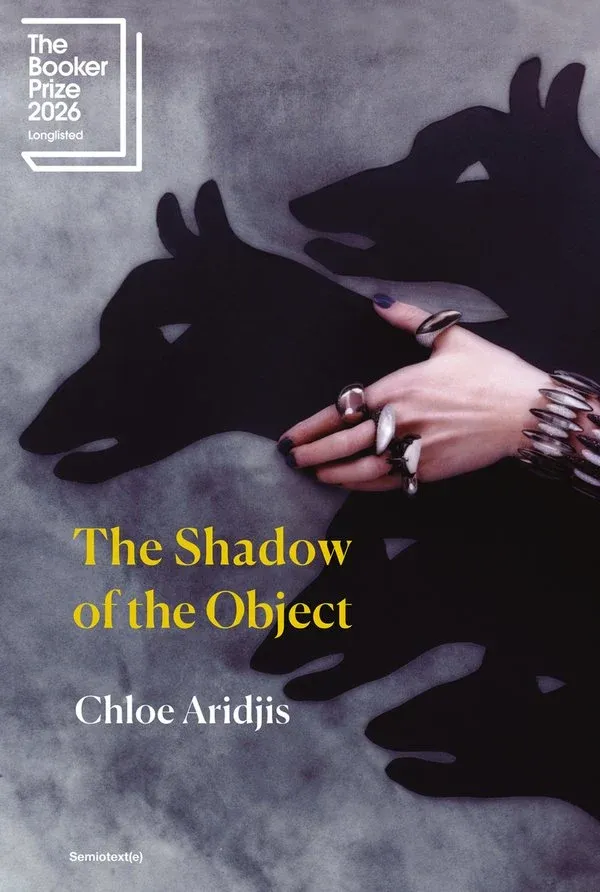
The Shadow of the Object by Chloe Aridjis
I can't succinctly tell you what The Shadow of the Object is about; it is certainly not a plot-forward novel. But I can say it's delightfully weird and compulsively readable. And there are so many beautiful sentences. Here's just a sliver of a self portrait of our heroine, Fiona: "Early forties. Phlegmatic, melancholic, yet prone to occasional acts of daring, a flat line interrupted by the sudden jump. If pressed, probably more centripetal and than centrifugal in nature, The hermit in me liked to stay home, the little vampire loved to step out. Sometimes they remained locked in battle for hours." Finally, some representation for the introverted extroverts!
Fiona lives in London but on a visit to her family home in Mexico she is bitten by the family dog who really didn't mean it. He's old and confused! Fiona's hand requires multiple surgeries and so she's stuck in the liminal space of the hospital for days. While there she meets Wilhelmina, a charismatic German woman who is also visiting from London, who gesticulates wildly and loves her cigarettes and who is (or was) an avid collector of old toys. She and her deceased husband had a collection that included "illusions created by movement, illusions created by a shift in illumination, and illusions created in some other way." I got a real Pee-wee's Playhouse kind of vibe, which of course is very good.
Fiona has a rapturous moment when Wilhelmina puts on a magic lantern show for her and the nurses in her hospital room. If magic lanterns (which were kind of like 19th century View Masters, devices that project slides) present a warped, upside down version of reality then they at least provide a moment to bask in the random beauty of the image. It's a lovely metaphor for fiction.
The latter part of the novel follows Fiona back to London, where she tracks down Wilhelmina's son and forges a friendship with him. But it's always the objects that take precedence. In the world of The Shadow of the Object, what we collect and what we desire (and what we're eager to get rid of) makes us who we are.
RIP Catapult

I'm not entirely sure what to say about the closure of Catapult, given how little we know about the future of its authors and books. So I will skip over the importance of indie presses and the unreliability of "benevolent" billionaires and instead focus on the workers at Catapult, and the many wonderful books they published.
But first, I'm gonna make it a little bit about me. My first layoff happened in 2007. I had worked at Counterpoint Press as an associate editor for four glorious months before the division was sold and I was out of a job. At that point, at least, Counterpoint still lived on. It would ultimately become a part of Catapult, along with Soft Skull Press. For me, well, there would be other jobs, but I never got to work in editorial and actually help make a book ever again. It still hurts! These are people's lives and senses of self-worth you're playing with!
At this point Counterpoint has been shut down and sold off so many times I just hope it lives to see another day.
More than anything I hope that anyone who was laid off got a good deal on severance and health insurance. Shout out to Catapult's union for fighting the good fight. I also hope thatthe authors who have contracts with Catapult for books publishing in 2027 and 2028 have some clarity soon.
And now onto the books. Here are some recent Catapult books that I've raved about. I don't have time for all new descriptions so when I can I will include links to what I previously wrote about them.
The Coin by Yasmin Zaher
Read about it here.
Theory & Practice by Michelle de Kretser
Read about it here.
A Real Animal by Emmeline Atwood
Read about it here.
A special shout out to Catapult's small but might collection of craft books that provoke and inspire.
Body Work: The Radical Power of Personal Narrative by Melissa Febos
Meander, Spiral, Explode: Design and Pattern in Narrative by Jane Alison
Craft in the Real World: Rethinking Fiction Writing and Workshopping by Matthew Salesses
New releases, 10/27
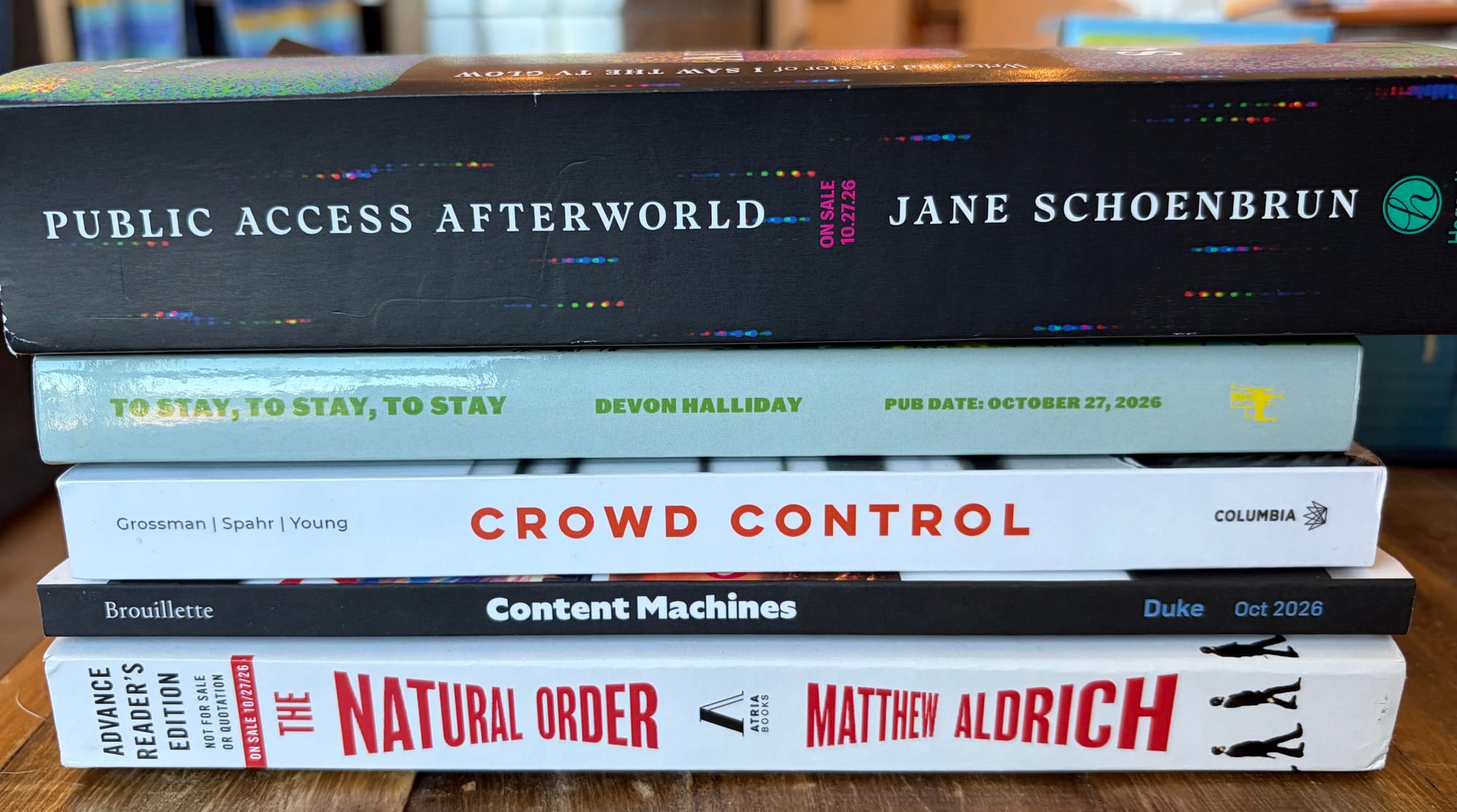
Public Access Afterworld by Jane Schoenbrun
I'm in the middle of Public Access Afterworld right now and I can't wait to tell you about it next week. A late entry for novel of the year.
To Stay, To Stay, To Stay by Devon Halliday
Crowd Control: The Racial Ordering of Literary Reward by Claire Grossman, Juliana Spahr, and Stephanie Young
Content Machines: Reading and Writing in the Platform Era by Sarah Brouilette
The Natural Order by Matthew Aldrich
They Told Me Back Home Would Be Beautiful: A Palestinian Memoir by Elena Dudum
Abandoning a Cat: A Personal Story by Haruki Murakami, translated by Philip Gabriel
We Thought They'd Never Leave: Musings on Food and Family by Tony Shaloub with Josie Adams
The Brightness by Chad Harbach
Citizen Kim: The Woman Who Created the Future by Jonathan Van Meter
Venus, Vanishing by Rebecca Birrell
Thousands of Eyes by Maximiliano Barrientos, translated by Thomas Bunstead