The Maris Review, vol 123

The theme of the week is one super chill question: who will you be when America descends into chaos?
What I read this week

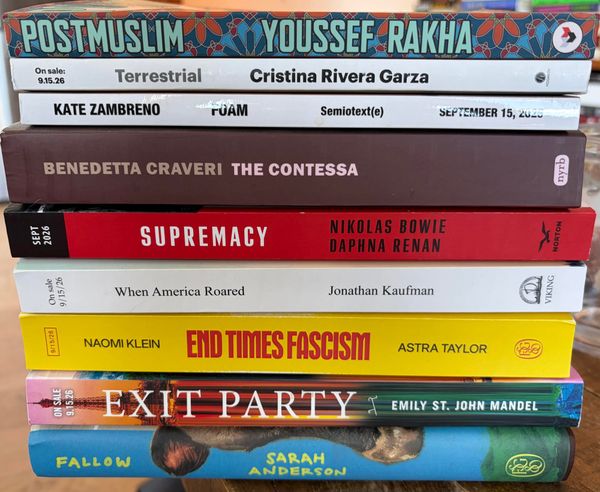
Exit Party by Emily St. John Mandel
I love how in her four most recent books Emily breaks the narrative of a dystopian novel into puzzle pieces and then she spends the length of the novel putting the pieces back together so they finally makes sense. There are jumps in timelines and dimensions and we learn not just what has happens to all of her characters but, seemingly the essential mystery, why. This one has the added bonus of showing us America in two different universes, both versions bleaker than our reality in the present, if you can believe it – one in which America is "fractured into disarray" and another where it's "closed like a fist."
Exit Party begins as the story of Ari Waker, a woman who was recently released from prison after twenty years, and who, in 2031, is attending a party in Silver Lake to celebrate the fact that curfew has been lifted after in the Republic of California. It's a world in which people live in and around malls, a la Ling Ma's Severance, and are constantly (when they can find enough gas) fleeing between former US states in attempt to find a safe place where militia violence isn't overwhelming.
That party in Silver Lake is vitally important, and we end up revisiting it many times throughout the course of the book. Spoiler alert, I guess: it contains a sliding doors moment when the two worlds briefly collide. Later in the novel we spend time with the other world version of Ari, who spies on her friends and neighbors in a surveillance state that makes Nazi Germany seem chill. Ari and her doppelganger beg the question: who do we become when America is crumbling? Is it better to be an actual criminal, or a criminal whose crimes are excused and justified by the government?
I'm talking a lot about larger systems here, but, as always, Emily does an excellent job of bringing us into the lives of her characters and making us care about them.
I forget who, but I saw someone talk about the Mandeliverse. And I just want to mention that I love how her characters carry over from book to book, just enough so you know that all of her novels take place in the same world (or worlds). There is something really hopeful about how the lives of her characters intersect. Even in a dystopian universe.
Speaking of dystopia...
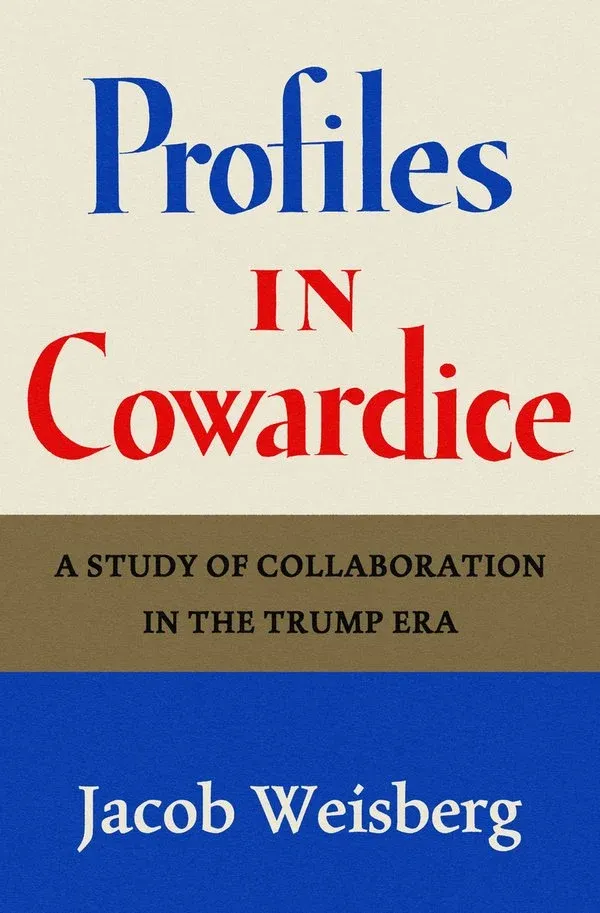
Profiles in Cowardice: A Study of Collaboration in the Trump Era by Jacob Weisberg
My guillotine is ready, that's all I can say.
Profiles in Cowardice is a very readable, infuriating little book about bootlicking. In the style of JFK's Profiles in Courage, each chapter covers a different figure who crumbled as the US has become more authoritarian. In other words, who folded like a little bitch when Trump grew more powerful and less tolerant of any kind of dissent. Who gave up all pretenses of morality or a backbone or integrity, mostly for personal gain.
For all of the insistence in the marketing copy that the book doesn't provide easy answers, it actually kind of does. The narratives about how and why each person folded is a little pat, as if they were diagnoses of all of these powerful people's fatal flaws. Jeff Bezos just really wants to beat Elon Musk at going to space. Brad Karp of Paul, Weiss just wanted to protect his rapidly expanding law firm. Mitch McConnell just wanted to build a conservative legacy, and he sure has succeeded there. Megyn Kelly just figured out that there is a lot more money to be made in rightwing media than there is on NBC. Stephen Schwarzman (Zibby's dad) just wants people to respect him, which is why he's always plastering his name on buildings. I will think about how much he wants to feel smart and special every time I go to the Stephen A. Schwarzman Building at the NYPL to do a book event.
A one-line diagnosis feels too simple, and yet maybe it's these people who most of all don't deserve nuance. A distinction between well-meaning hacks like Karp and George W. Bush and those ghoulish figures who never really had a soul in the first place – most of the rest of them. Their one commonality: they all, at one point, were set up to stand up to the bullying of the second Trump administration. All found it in their best interest not to.
In the conclusion of the book Weisberg reflects on the nature of moral courage: "In the Trump era courage is the readiness to bear responsibility in the open, even at personal risk or professional cost." This line resonates with me so much, but it also makes clear how difficult it is for the average person to take a stand. It occurred to me recently that speaking out about politics or AI or evil rich people can be extra dangerous when you depend on a particular job at a particular corporation in order to get health insurance. If that's not dystopia, what is.
Nonfiction is doing great, you guys!
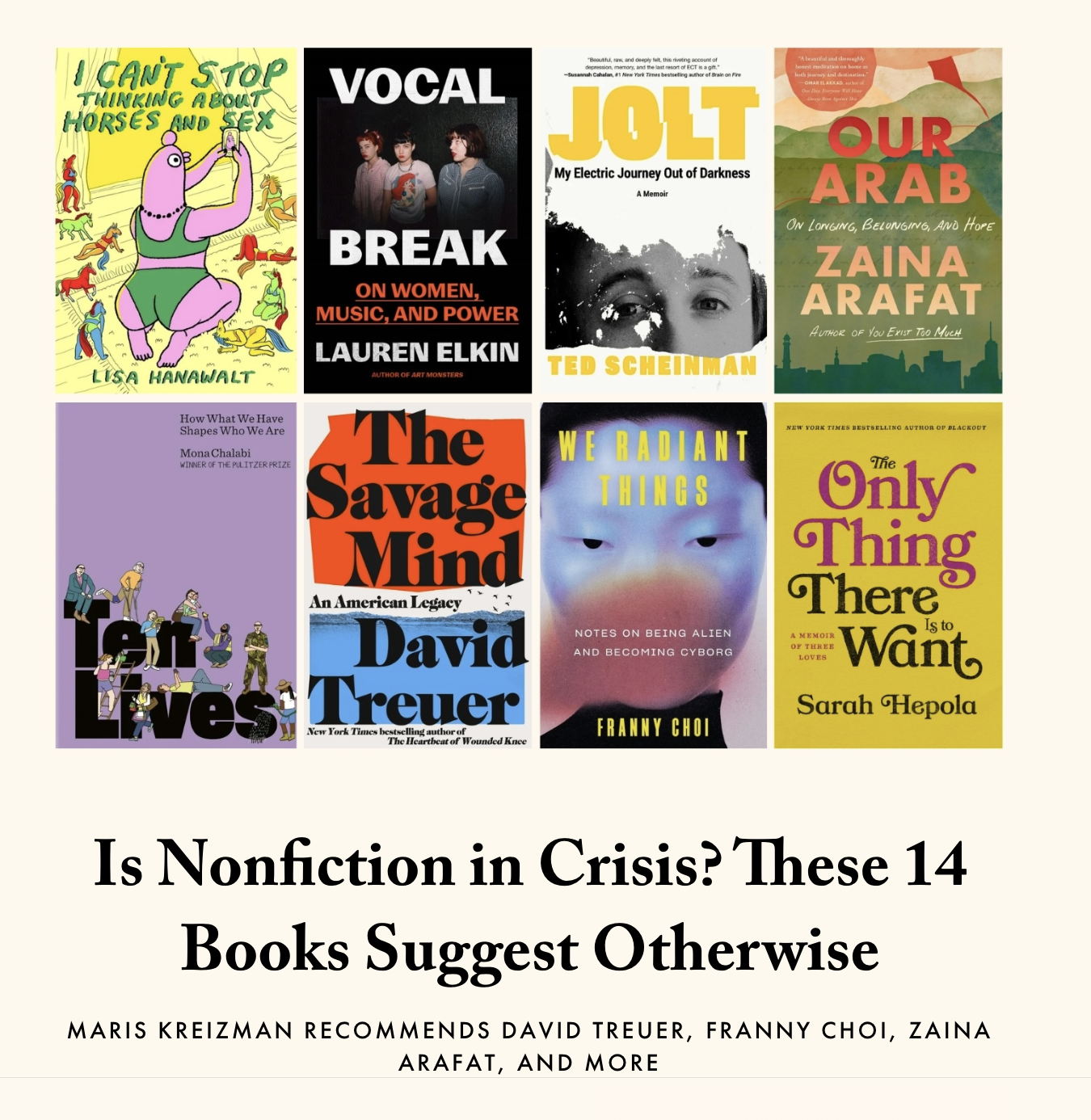
For my column at Lit Hub I did a nonfiction fall preview mostly because I hate the discourse about how nonfiction is "dying" and that publishers are no longer interested in publishing it. There is so much good stuff coming out this fall. But they tend to get less media coverage than the big novels, and I totally get that. But I wanted to show them a little love, too. I know that escapism is big now and I totally understand why, but being curious about the world we live in is very helpful too.
New releases, 9/22
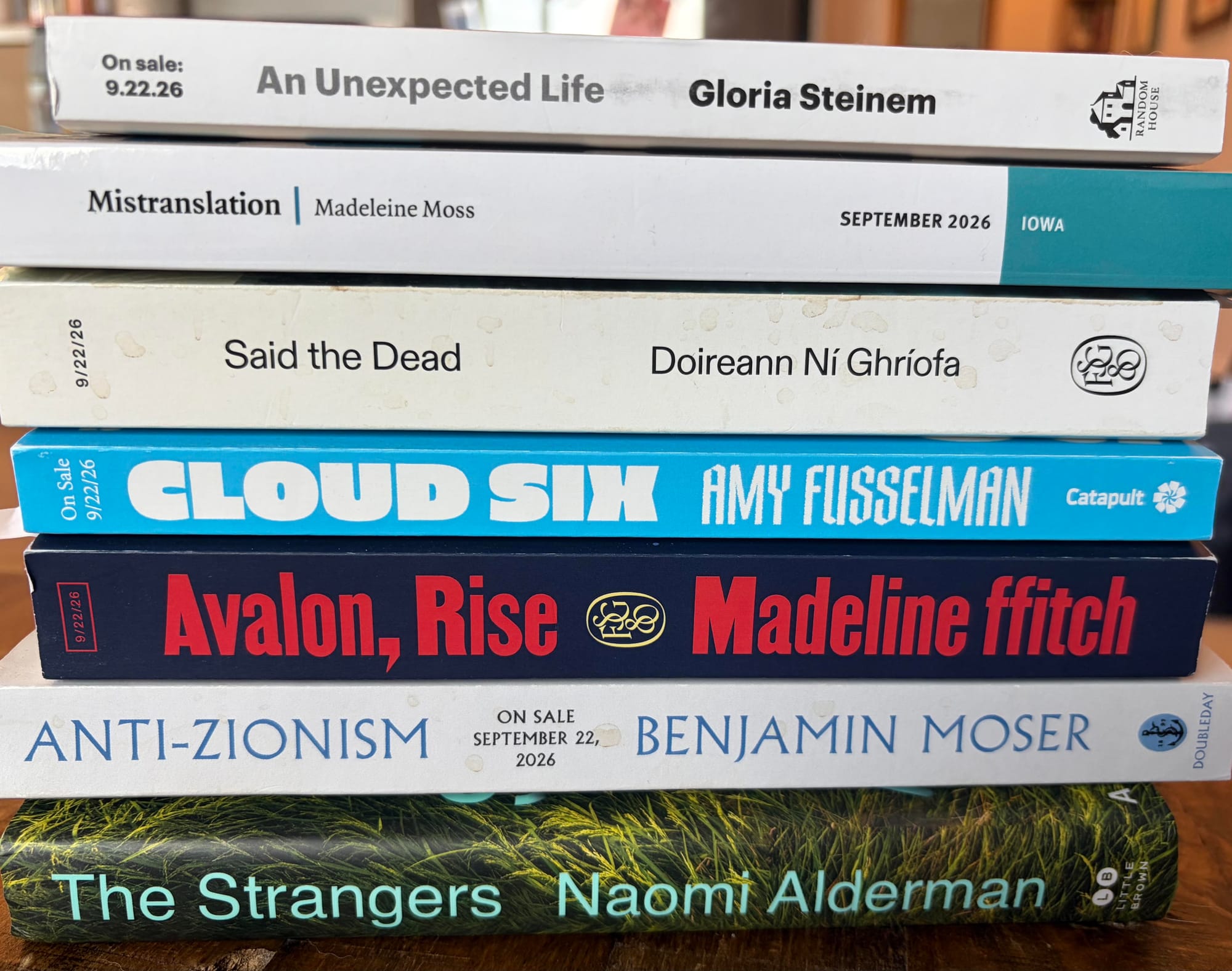
An Unexpected Life: A Memoir by Gloria Steinem
Mistranslation by Madeleine Moss
Said the Dead by Doireann Ní Ghríofa
Cloud Six by Amy Fusselman
Avalon, Rise by Madeline ffitch
The Strangers by Naomi Alderman
Female Life on Planet Earth by Laleh Khadivi
Birth of a Culture by Grandmaster Flash with Scoop Jackson
Our Cut of Salt by Deena Helm
Hollywood, Ending by John Green
History by a Hair: Thomas Jefferson, Sally Hemings & Solving a 200-Year-Old Mystery by Richard Kurin
Rock: A Mainstream Alternative History of Alternative Mainstream Music by Chuck Klosterman
True North: On the Road in Canada by Paul Theroux
Brought to You By: How Corporations Warped the Truth, Conned the Public, and Broke Democracy by Amy Westervelt
Incarnate by Alma Katsu